
Updated 8 August 2026. Cashew buyers cannot remove price volatility, but they can decide in advance how price risk will be measured, shared and documented. A strong contract does more than choose “fixed” or “floating”: it defines the product, quantity, delivery basis, reference data, observation dates, adjustment formula, fallback method and dispute path.
This guide presents three practical structures for Vietnam-origin cashew kernel programmes. It is a commercial drafting checklist, not legal advice. Parties should ask qualified counsel to adapt the final wording to the governing law, the countries involved and their risk policies.
Start with a contract data sheet
Price clauses fail when the underlying trade is vague. Before selecting a pricing structure, put the following items in one agreed data sheet or schedule.
| Contract item | Minimum detail to agree | Why it affects price risk |
|---|---|---|
| Product | Grade, count or piece size, moisture, defects, colour and approved sample | Different specifications are not interchangeable benchmarks |
| Quantity | Total volume, shipment lots, tolerance and call-off dates | Determines raw-material and production coverage |
| Packing | Vacuum bag, carton, retail pack, net weight, marks and artwork | Changes conversion, material and labour cost |
| Delivery rule | Named Incoterms® 2020 rule and named port/place | Allocates tasks, costs and delivery risk |
| Shipment | Window, booking responsibility, documents and delay consequences | Links price validity to freight and operational timing |
| Payment | Currency, timing, bank instrument, charges and late-payment terms | Creates currency, financing and counterparty exposure |
| Claims | Inspection, sampling, notice period, evidence and remedy | Prevents a price dispute from becoming a quality dispute |
| Law and disputes | Governing law, CISG treatment, forum, language and notice method | Determines how ambiguous clauses may be interpreted |
Review the Le Duong product portfolio and the cashew specification buyer guide before fixing the commercial schedule.
Structure 1: fixed price for defined volume
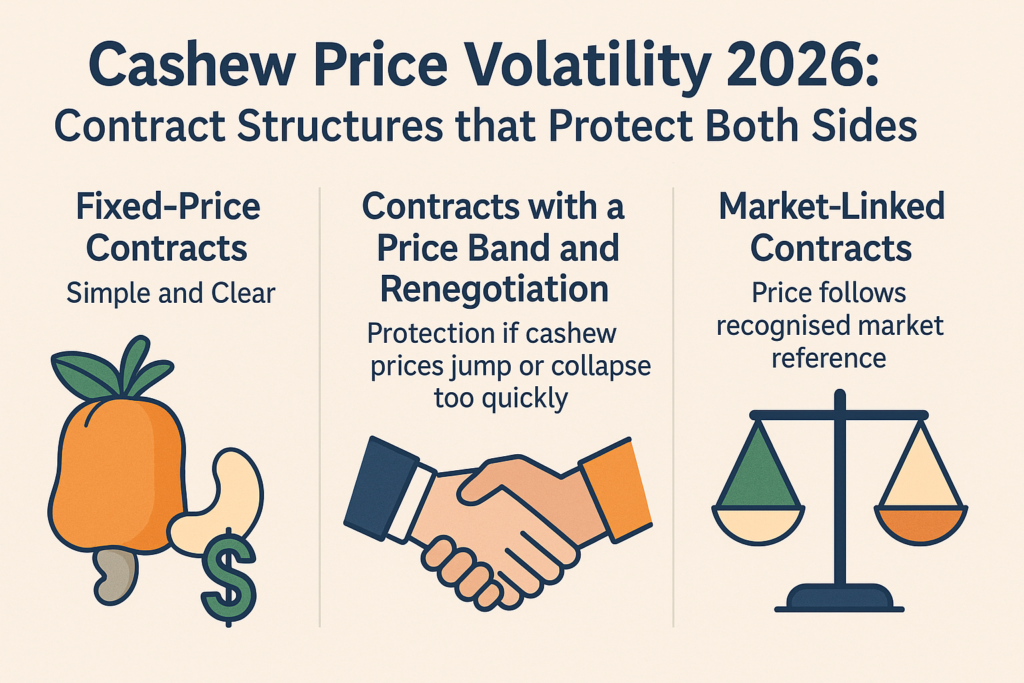
A fixed-price contract states one price for a defined grade, specification, packing, delivery rule, quantity and shipment period. It is most useful when the buyer has firm sales commitments or needs predictable unit cost.
What to write down
- price per kilogram and currency;
- exact product and packing schedule;
- Incoterms® 2020 rule plus named port or place;
- firm quantity and permitted tolerance;
- shipment windows and call-off deadline;
- whether freight, insurance, duties or bank charges are included;
- consequences of buyer postponement or supplier delay; and
- any clearly defined hardship or renegotiation mechanism.
A fixed product price does not necessarily fix landed cost. Under FOB, for example, the buyer remains exposed to main carriage; under CFR or CIF the seller arranges main carriage, but the precise delivery and risk-transfer rules still come from the named Incoterms® rule. ICC advises using the rule with a named place or port and the 2020 version.
Best fit: base demand with reliable forecasts. Main trade-off: one party may be out of market if raw material, freight or exchange rates move after signing.
Structure 2: fixed base price with a band
A band structure keeps the starting price unchanged while a defined reference stays within an agreed range. When the reference crosses the threshold, the contract applies a stated adjustment or triggers a review.
Define six points—never just “market moves significantly”
- Reference: name the exact publication, quotation basket or other verifiable input.
- Baseline: state the value and date or averaging window used at signing.
- Observation: set the dates, time zone and averaging method for each shipment.
- Threshold: define the band, such as a percentage above or below baseline.
- Mechanism: say whether adjustment applies to the full move or only the amount outside the band.
- Fallback: explain what happens if the reference stops publishing or becomes unrepresentative.
Cashew kernels do not have one universally mandatory public benchmark for every origin, grade and term. A contract that refers only to “the market price” is difficult to reproduce. If the parties use a quotation basket, identify the contributors, eligible grades, Incoterm, observation window, outlier rule and calculation record. Each side should be able to reach the same result from the same inputs.
Best fit: medium-term programmes where both sides can absorb ordinary movement but want protection from an agreed extreme. Main trade-off: a renegotiation-only trigger can create deadlock unless the contract includes a timetable and default outcome.
Structure 3: formula-linked price
A formula-linked contract resets the shipment price on agreed dates. The formula may reflect one or more measurable components, such as a specified raw-material reference, ocean freight for the named route or an agreed currency rate.
A simplified framework could be written as:
Illustrative formula: shipment price = base product price + the agreed share of raw-material movement + freight movement allocated per net kilogram.
This is only a framework. The contract must define the source, baseline, observation date, currency, unit, conversion factor, container net weight, rounding and any cap or floor.
Formula control checklist
- Use the same currency and unit for every input.
- State whether monthly data are an average, median, close or published assessment.
- Specify rounding at both input and final-price level.
- Set a cap, floor or review point if required by either risk policy.
- Keep a calculation sheet with the source evidence for every reset.
- Add a fallback hierarchy for missing, delayed or discontinued data.
Best fit: recurring volume with mature procurement and finance controls. Main trade-off: transparency improves, but basis risk remains if the formula input does not move like the contracted cashew grade.

Worked band example
Assume a contract sets a base price of US$7.00/kg and an agreed reference baseline of 100. The band is ±5%. The observation value for the next shipment is 112.
| Method | Calculation concept | Result before any cap |
|---|---|---|
| Full-move adjustment | Apply the entire +12% reference move after the trigger is crossed | US$7.84/kg |
| Excess-only adjustment | Apply only the 7 percentage points above the +5% band | US$7.49/kg |
| Renegotiation trigger | No automatic number; parties negotiate within a stated period | Depends on agreed outcome or fallback |
All three are possible commercial designs, but they produce different results. The contract must name one. It should also say whether the calculation is symmetric when the reference falls.
Hardship is not the same as force majeure
ICC publishes separate 2020 model clauses for force majeure and hardship. In broad terms, force majeure concerns an event that prevents or impedes performance, while hardship concerns events that fundamentally alter the contract’s equilibrium. UNIDROIT’s Principles similarly treat hardship as a fundamental alteration caused by qualifying events and provide a framework for requesting renegotiation.
A price increase should not automatically be labelled force majeure. The effect depends on the contract wording, facts and governing law. If the parties want an extreme raw-material, freight, tariff or currency movement to trigger a review, they should define that commercial trigger expressly rather than assume a general clause will rewrite the price.
A robust review clause states:
- the measurable event and threshold;
- who must give notice, how and by when;
- the evidence required;
- whether performance continues during review;
- the negotiation period; and
- the outcome if no agreement is reached—existing price, expert determination, suspension or termination for future lots.
Do not let the price clause conflict with the rest of the contract
Pricing, delivery and legal clauses work together. The United Nations Convention on Contracts for the International Sale of Goods (CISG) may govern qualifying international sales when its conditions are met, unless the parties validly exclude it. Incoterms® rules allocate defined delivery tasks, costs and risks, but they do not replace provisions on title, payment, quality, breach, governing law or dispute resolution.
Before signature, reconcile the price schedule with:
- the product specification and approved sample;
- the named Incoterms® 2020 rule and place/port;
- shipment tolerances and partial deliveries;
- inspection, rejection and claim remedies;
- currency conversion and banking days;
- tax, duty and tariff-change allocation;
- force majeure and hardship language; and
- governing law, CISG position and dispute forum.
For delivery-risk context, see the FOB, CIF and CNF buyer guide.
A practical portfolio approach
Many buyers do not need one structure for every tonne. A procurement programme can use fixed pricing for committed base volume, a band for forecast volume and spot or formula-linked pricing for optional demand. The allocations must still be explicit: grade, quantity, shipment month and which price schedule applies to each lot.
Frequently asked questions
Which cashew contract structure is safest?
None is universally safest. Fixed pricing improves budget certainty, bands share defined extremes and formulas improve traceability. The right choice depends on sales commitments, forecast confidence, cash flow and the ability to verify reference data.
Can a contract simply use “prevailing market price”?
That phrase is difficult to reproduce without a named source, grade, trade term, observation date and calculation method. Define those elements or use a documented quotation procedure.
Does CIF fix all landed costs and risks?
No. CIF allocates particular seller and buyer obligations under Incoterms® 2020, including specified insurance and freight responsibilities, but it does not determine every duty, tax, payment, title, quality or legal issue.
What should happen if a price reference disappears?
Use a fallback hierarchy: a named replacement source, a defined quotation basket or independent expert determination. State when the fallback begins and how historical continuity is handled.
Should a sharp price rise be treated as force majeure?
Not automatically. Contract language, facts and governing law control the result. If price movement should trigger adjustment or renegotiation, define the threshold and procedure expressly and obtain legal review.
Primary references
- International Chamber of Commerce: Incoterms® 2020
- ICC Force Majeure and Hardship Clauses 2020
- UNIDROIT Principles, Chapter 6 Section 2: hardship
- UNCITRAL: United Nations Convention on Contracts for the International Sale of Goods
To discuss grade, quantity, packing, destination and shipment timing, follow the ordering process or request a quotation. Commercial terms remain subject to review and written agreement.