Quick answer: cashew kernels usually darken during frying because heat drives non-enzymatic browning, especially the Maillard reaction between amino compounds and reducing sugars. Uneven or excessive browning, however, is normally a process-control problem involving time, temperature, moisture distribution, kernel size, oil condition or a combination of these factors.
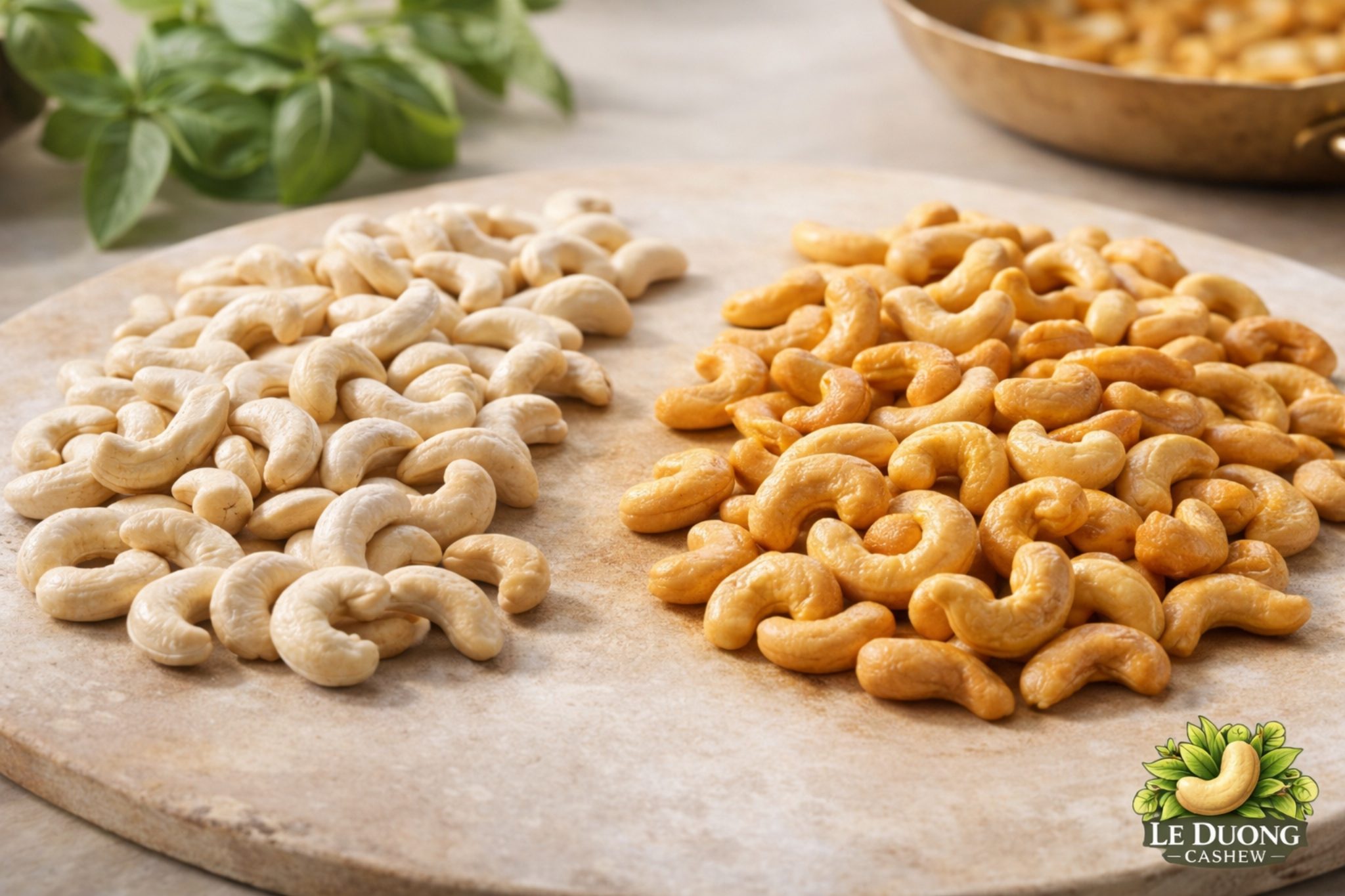
Buyers should distinguish an intended light-golden roast colour from irregular dark patches, burnt edges or a batch that becomes progressively darker during a production run. Colour alone does not identify the root cause, so the observation must be checked against process records and retained samples.
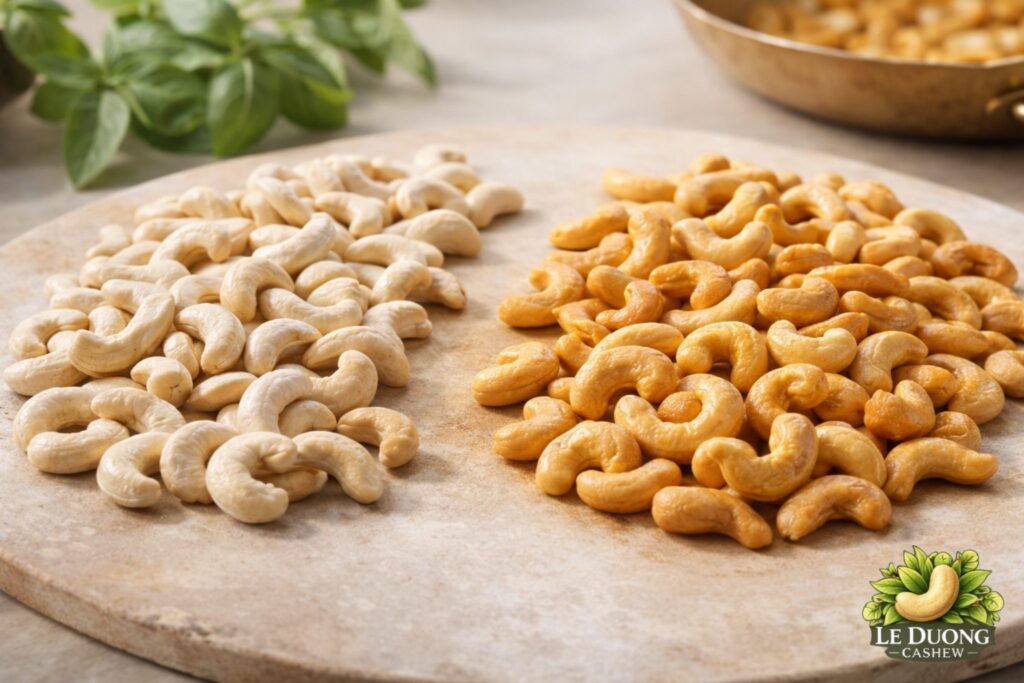
Why cashew kernels turn brown under heat
The main mechanism is the Maillard reaction. It creates desirable roasted colour and aroma, but the reaction accelerates as the heat load increases. Cashew-specific roasting studies found that time and temperature materially change kernel lightness, browning index, moisture and texture. Microwave-heating research on cashews likewise measured colour change together with moisture loss and surface-temperature rise.
This evidence is useful for diagnosing fried kernels, but it is not a universal fryer recipe. Heat transfer differs between hot air, microwave, radio-frequency roasting and oil frying. Every processor should validate its own equipment, oil, batch size, grade and target colour.
Diagnostic table: symptom, likely cause and first check
| Observed symptom | Likely contributors | First control check |
|---|---|---|
| The whole batch is darker than the approved reference | Excessive oil temperature, excessive residence time or an inaccurate sensor | Compare the actual oil temperature and recorded frying time with the validated process window |
| Pale and dark kernels occur in the same batch | Mixed size, uneven starting moisture, poor agitation or uneven heat distribution | Check grade segregation, moisture sampling positions, loading depth and product movement |
| Thin ends, splits or broken pieces darken first | Smaller thermal mass and mixed whole/broken material | Remove off-grade pieces and run a size-consistent trial |
| Colour becomes darker later in the production shift | Temperature drift, accumulated fines, oil ageing or reduced filtration efficiency | Trend the actual temperature, oil turnover, filtration record and the applicable oil-quality indicators |
| Isolated dark spots remain after an otherwise normal fry | Residual testa, shell material, damaged tissue or local contamination | Inspect pre-fry sorting, peeling and foreign-material controls |
| Dark colour is accompanied by burnt or stale flavour | Over-processing, oxidised raw material or degraded oil | Hold the lot, conduct sensory and oil-quality checks, and compare retained incoming and finished samples |
Five technical causes to investigate
1. Temperature and residence time
Temperature is usually the fastest variable to check. A small set-point change can represent a larger heat-load change when the fryer is lightly loaded, when circulation changes or when the sensor does not reflect the hottest zone. Time and temperature must therefore be recorded together, not evaluated separately.
2. Starting moisture and moisture uniformity
Water absorbs heat and its evaporation changes surface conditions. Research on cashew heating shows moisture loss occurring alongside colour development. The practical issue is not only the lot average: two samples with the same average moisture can fry differently if moisture is unevenly distributed among kernels. Use a documented sampling plan rather than relying on one reading from one bag.
3. Kernel grade and size distribution
WW180, WW240, WW320, splits and small pieces do not have the same geometry or heat-transfer behaviour. Mixing sizes makes a single time-temperature setting less reliable. Process trials should use a defined grade and record the percentage of broken or off-size material.
4. Raw-material composition and storage history
Natural variation in sugars and amino compounds can influence browning response. Storage condition may also change flavour and oxidation status. Treat this as a secondary hypothesis after verifying the measurable process controls; do not reject a lot based on colour speculation alone.
5. Oil condition, filtration and carry-over residue
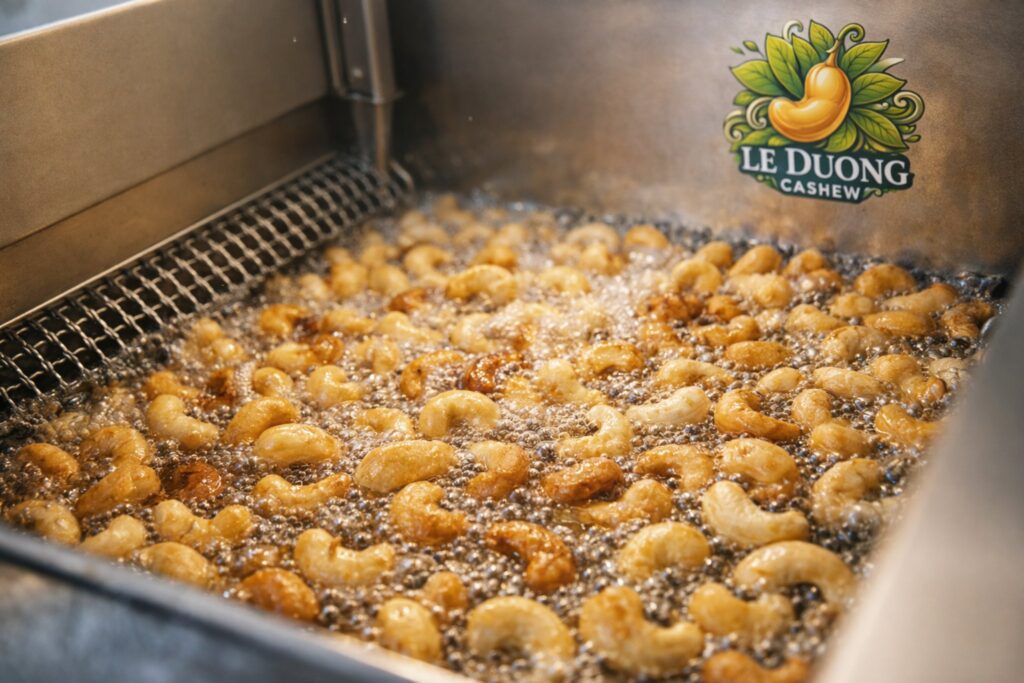
Repeated heating promotes oxidation, hydrolysis and polymerisation in frying oil. Food particles and fines can also continue to brown in the system. Oil type, turnover, replenishment, filtration and the applicable legal or internal oil-quality limits should be part of the batch record.
Practical control plan for processors
- Define the target. Agree an approved physical sample, a controlled colour chart or instrument-based L*a*b* limits where appropriate.
- Segregate the input. Use one defined kernel grade and remove off-size pieces before validation trials.
- Measure representative moisture. Sample more than one position or package and document the method used.
- Validate the fryer. Record actual temperature, batch load, residence time and cooling conditions. Do not copy a setting from another machine.
- Control the oil. Document oil type, additions, filtration, turnover and quality checks required by the destination market and the processor’s food-safety plan.
- Retain evidence. Keep incoming and finished samples, photographs under consistent lighting and traceable batch records.
What cashew buyers should specify
A purchase specification should state the kernel grade, acceptable broken percentage, moisture limit, colour expectation, packing, intended application and inspection method. For frying or seasoning lines, share the expected finished colour and process type with the supplier before confirming the lot.
Le Duong Cashew provides whole white cashew kernels for roasting and ingredient applications and salt-roasted cashews with testa in selected wholesale formats. Buyers can review the Quality Documents Centre and send the grade, packing, quantity and destination for specification matching.
Buyer FAQ
Does a darker fried kernel always mean the raw cashew was low quality?
No. Excessive time, temperature drift, mixed sizes, uneven moisture or oil-management issues can darken an otherwise acceptable raw kernel. Diagnose the process and retained samples before assigning the cause.
Can moisture alone explain uneven colour?
No. Moisture is important, but grade distribution, fryer loading, heat uniformity, residence time and oil condition may act at the same time.
What is the best frying temperature for cashews?
There is no single universal temperature. The correct setting depends on equipment, oil, grade, batch load, starting moisture and target colour. Establish a validated operating window through controlled trials.
Should colour be included in the purchase specification?
Yes, when appearance matters to the finished product. Use an approved sample or a repeatable measurement method and define the inspection lighting and acceptance procedure.
Technical sources
- Olatidoye et al., temperature-time effects on roasted cashew colour, moisture, texture and acceptability.
- Hebbar et al., cashew quality as influenced by microwave heating.
- Liao et al., hot air-assisted radio-frequency roasting of cashew kernels.
- Bazina et al., chemical changes and degradation mechanisms in deep-fat frying.
Technical review updated 8 August 2026. Roasting research is used here to explain heat-driven browning; each frying line still requires its own validated controls.