

Vietnam cashew kernels supplier for UAE & Saudi halal snack brands (new crop)
GCC snack brands are moving fast: shorter launch cycles, private label expansion, and tighter buyer specifications. For procurement and QA teams, new crop sourcing is not only about taste and color—it’s about consistent grade availability, defined defect limits, and documentation readiness for UAE and Saudi import workflows.
If you’re qualifying a Vietnam cashew kernels supplier for WW320 and WS, this guide outlines what to verify from crop to container—especially when your brand follows halal-facing handling expectations (note: cashews are plant-based; halal assurance relates to handling controls and supporting documentation, not the ingredient itself).
Explore export options and request spec alignment: https://leduongcashew.com/en/
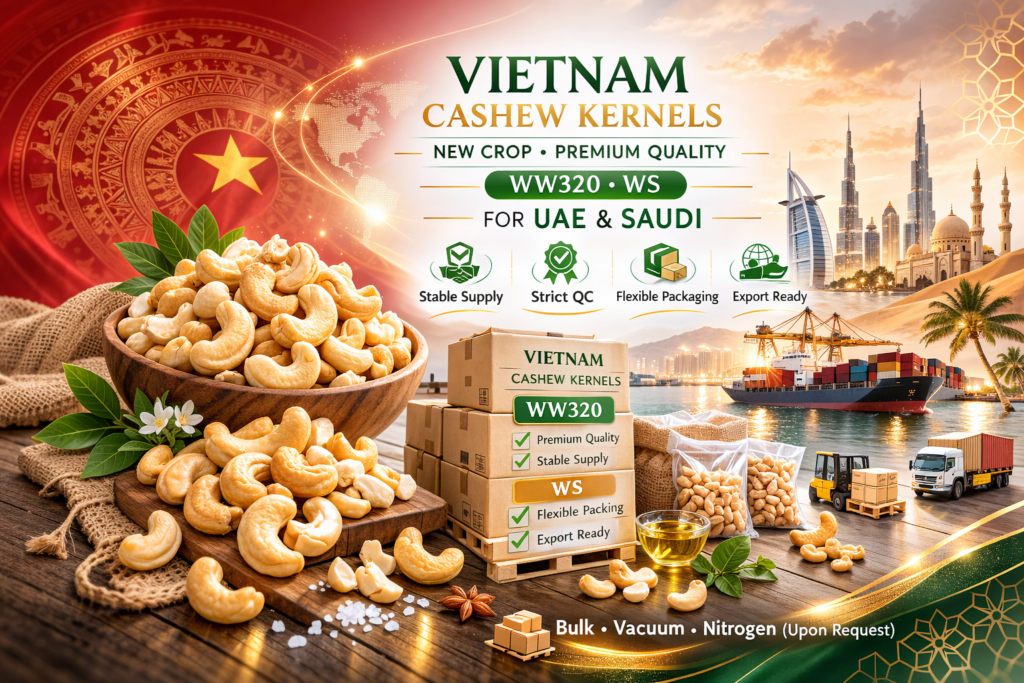 Why “new crop” matters for GCC snack lines
New crop Vietnam kernels typically support:
-
Cleaner sensory profile for roasted and flavored SKUs
-
More stable color range when lots are well-managed
-
Better processing predictability for roasting curves and seasoning adhesion
-
Lower risk of long-storage off-notes when inventory rotation is controlled
For UAE and Saudi, this can translate into fewer reworks, tighter in-line QC outcomes, and more reliable finished-pack consistency.
Product focus: WW320 + WS for snack manufacturing
WW320 (Whole White 320)
WW320 is widely used for:
-
Premium roasted & salted
-
Honey / spice-coated
-
Chocolate-enrobed snack applications
-
Mixed nuts blends requiring uniform size
Key checks to align with buyer specs:
-
Moisture target and validated drying controls
-
Defined defect limits (e.g., broken, scorched, spotted) aligned with your spec sheet
-
Lot uniformity across pallets to reduce production variance
WS (Wholes/Butts/Splits or White Splits, per buyer definitions)
WS-grade components are often selected for:
-
Seasoned snack mixes
-
Portion packs where whole visual is less critical
-
Better cost control while maintaining a “white kernel” appearance in blends
Important: “WS” can be defined differently by buyers. Your purchase contract should specify:
-
Kernel type definition (splits, butts, large pieces)
-
Sieve/size expectation (if applicable)
-
Allowed % of small fragments and foreign matter limits
Halal snack brands: what “halal-ready” means for cashews
Cashews are plant-based, so the halal consideration typically focuses on handling controls and process integrity rather than ingredient permissibility.
A Vietnam cashew kernels supplier supporting halal snack brands in UAE/Saudi should be able to provide, upon request:
-
Handling statements (clean storage, segregation practices where relevant)
-
Cleaning and allergen cross-contact controls
-
Batch traceability records (lot coding, packing dates, container mapping)
-
Documentation pack aligned with your importer and destination requirements
This approach helps brands maintain consistent internal governance without making over-claims.
Stable supply: what to verify beyond “availability”
“Stable supply” is measurable when a supplier can demonstrate:
-
Capacity planning (monthly output capability for WW320 & WS)
-
Lot consolidation discipline (consistent quality across container loads)
-
Raw material sourcing strategy (diversified intake to reduce disruption risk)
-
Shipment readiness (lead times, booking ability, loading supervision)
Ask for historical shipment patterns (volume ranges, seasonality handling) rather than generic promises.
QC system checkpoints GCC buyers expect

Vietnam Cashew Kernels Supplier for GCC Halal Snacks
For UAE/Saudi snack manufacturing, QC isn’t just a COA. A process-oriented supplier should support:
-
Incoming inspection criteria for raw input
-
In-process controls: sorting stages, metal detection, moisture checks
-
Final release based on agreed spec sheet (AQL or defect definition)
-
Inspection records available per lot (photos, checklists, sampling notes)
Common GCC-aligned risk controls:
-
Defined foreign matter control steps
-
Container loading checks (dryness, odor, pallet condition)
-
Packaging integrity testing (seal strength and liner checks when applicable)
Export docs: keep customs and inbound QA moving
A documentation-ready exporter can support smoother clearance and faster receiving in UAE/Saudi warehouses. Typical export documentation set may include (subject to destination and buyer requirements):
-
Commercial Invoice + Packing List
-
Certificate of Origin (when applicable)
-
Bill of Lading / Sea Waybill
-
Health/Sanitary or quality statements (as requested)
-
Lot coding and container packing map for traceability
Your importer may also request additional paperwork depending on channel and registration needs.
For documentation support and export alignment: https://leduongcashew.com/en/
Flexible packaging for GCC snack brands
Flexible packaging matters for:
-
Preserving kernel texture during long-haul sea freight
-
Managing humidity risk
-
Optimizing warehouse handling and repacking
Common options (subject to buyer specs):
-
Vacuum packs or nitrogen-flushed inner bags
-
Food-grade liners with robust outer cartons
-
Palletization patterns optimized for container utilization
-
Custom carton labeling (private label codes, Arabic/English marks as required—without regulatory stamp imitation)
Buyer FAQ (UAE / Saudi)
1) What grades are best for premium roasted SKUs?
WW320 is widely used for premium roasted lines due to size uniformity and visual appeal. WS can be suitable for mixes or value-oriented SKUs where whole appearance is less critical.
2) Can you support halal requirements for snack brands?
Cashews are plant-based. Halal-facing assurance typically relates to handling controls and documentation. A supplier can support handling statements and traceability records upon request, aligned with buyer requirements.
3) How do we reduce quality variation across a full container?
Ask for lot consolidation rules, pallet mapping, and final QC release criteria aligned with your defect limits. Consistent sorting and documented sampling help reduce variance.
4) What documents should we request for UAE or Saudi imports?
Commonly: Invoice, Packing List, Bill of Lading, Certificate of Origin (if required), plus lot/traceability details. Exact needs depend on the importer, channel, and destination rules.
5) What packaging is recommended for sea freight to GCC?
Moisture-managed inner bags (vacuum or inert gas options) with strong outer cartons and clean palletization can help protect texture and reduce odor/moisture risk, subject to buyer spec.
6) Can we request private label carton markings?
Yes, many exporters can support customized carton labels and pallet marks per buyer instruction—ensure they remain compliant and do not mimic official stamps.