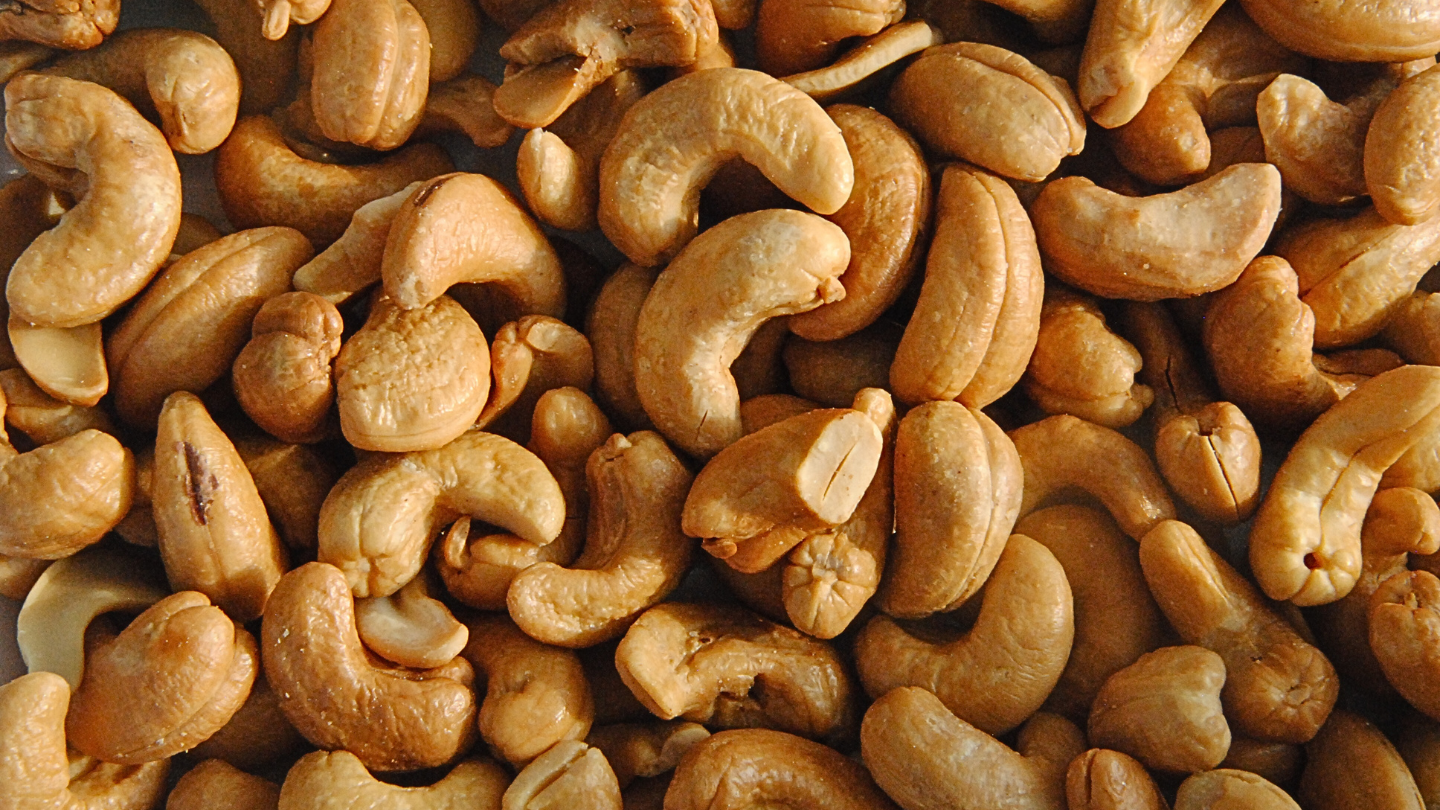


Vietnam Cashew Export Report January 2026
January’s export declarations provide a practical “baseline month” for buyer planning across 2026—useful for procurement teams benchmarking grade availability, Incoterm patterns, and supplier consistency. The report scope covers Vietnam cashew-only shipments (HS 080132/080131/200819) across all destinations.
In this dataset, the total shipped quantity is 53,378,965 kg (≈53,378.965 MT) with total declared value of $1,966,396,296, and a weighted average price of 36.8384 (Value/Qty). Note: pricing and KPI calculations exclude non-convertible unit rows; 3,786 / 4,055 rows were convertible in-unit for KPI conversion.
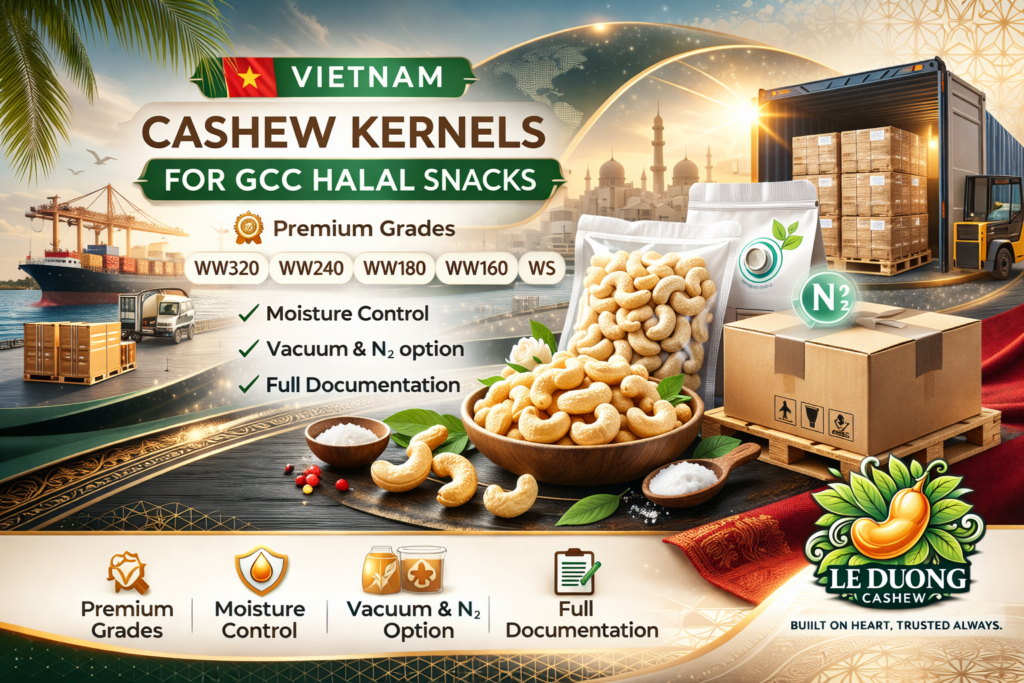
Vietnam Cashew Kernels Supplier for GCC Halal Snacks
Table of Contents
-
What January 2026 signals for global cashew buyers
-
Grade mix and best-fit applications (WW320/WW240/WW180 + processed lines)
-
Buyer landscape: importer ranking and how to use it safely
-
Price signals by Grade × Incoterm (and how to handle outliers)
-
QC approach for export contracts (moisture, defects, foreign matter, traceability)
-
Packaging & labeling options for stable clearance
-
Export documentation checklist to avoid delays/demurrage
-
Logistics notes: lead time, container planning, and hot-climate storage
-
Supplier evaluation checklist (verification points before contracting)
-
Buyer FAQ + Internal link suggestions
1) What January 2026 signals for global cashew buyers
Because the dataset contains only one month, seasonality visuals should be treated as a baseline for 2026, not a full-year pattern.
For importers, the practical value is operational:
-
Benchmarking declared pricing bands by grade and Incoterm
-
Screening buyer stability via repeatable volume profiles (even with masked names in public copies)
-
Reducing landed-cost surprises by aligning Incoterms, payment terms, and QC specs early in the deal cycle
Vietnam Cashew January 2026 Export Report
2) Grade mix and best-fit applications (WW320/WW240/WW180 + processed lines)
A grade summary extracted from product descriptions shows meaningful volume concentration in kernels and mainstream white wholes, plus a notable share of processed lines. (Non-standard lines are grouped as OTHER/ROASTED/SHELLED.)
Grade summary (January 2026)
-
KERNEL: 22,445.195 MT | $510,281,259 | Avg $22.7345/kg
-
WW320: 13,061.405 MT | $182,705,756 | Avg $13.9882/kg
-
WW240: 5,548.888 MT | $949,357,645 | Avg $171.0897/kg
-
ROASTED: 4,993.326 MT | $34,685,266 | Avg $6.9463/kg
-
WS: 2,158.401 MT | $12,199,180 | Avg $5.6520/kg
-
SP: 1,428.562 MT | $8,056,545 | Avg $5.6396/kg
-
LP: 1,393.022 MT | $6,040,144 | Avg $4.3360/kg
-
WW180: 893.318 MT | $253,241,668 | Avg $283.4843/kg
-
WW450: 795.690 MT | $5,326,093 | Avg $6.6937/kg
-
SHELLED: 283.897 MT | $1,846,666 | Avg $6.5047/kg
-
WW210: 271.814 MT | $2,197,779 | Avg $8.0856/kg
Best use-case guidance (buyer-facing)
-
WW320: scalable mainstream programs (snack, bakery, retail packs, ingredient) where consistent sizing and supply continuity matter.
-
WW240 / WW180: premium visual grades often used when appearance drives value (gift packs, premium mixes, select retail SKUs).
-
WS/SP/LP & processed lines (e.g., roasted): price-sensitive channels, foodservice, industrial blends, or niche specs—useful, but typically require tighter defect and breakage alignment.
If you want a shortlisting approach for 2026 contracting, a practical strategy is to prioritize WW320/WW240 for scalable contracts, while using processed lines for niche channels as needed.
3) Buyer landscape: importer ranking and how to use it safely
The report includes a public-safe masked ranking of top importers (first 5 alphanumeric characters). The top importers by quantity in January include:
-
OLAMI — 10,137.653 MT | $70,215,113 | Avg $6.9262/kg
-
REDRI — 2,005.499 MT | $13,786,227 | Avg $6.8742/kg
-
LONGZ — 1,353.137 MT | $8,583,755 | Avg $6.3436/kg
-
CONGT — 1,349.140 MT | $8,802,878 | Avg $6.5248/kg
-
THERI — 1,031.015 MT | $7,187,023 | Avg $6.9708/kg
How buyers should use this list
-
Treat it as a signal for volume concentration and potential repeatability—not a guarantee of contract terms.
-
Pair it with due diligence: credit/payment terms, inspection regime, dispute handling, and documentation readiness.
The report explicitly states that the full unmasked buyer list is internal and can be requested via the Le Duong Cashew Trade Desk for match-making support.
Mid-article CTA (contextual): If your procurement team wants buyer matching, contract support, and QA alignment, request the internal list and support via https://leduongcashew.com/en/
4) Price signals by Grade × Incoterm (and how to handle outliers)
The report provides a split table per grade showing Min / weighted Avg / Max by Incoterm. Example (KERNEL grade):
-
FOB: 8,612.923 MT | Min 0.5000 | Avg 6.6297 | Max 10.1200
-
DAP: 7,263.172 MT | Min 0.2300 | Avg 6.8310 | Max 9.3524
-
CFR: 2,990.164 MT | Min 0.4913 | Avg 118.6868 | Max 7,575.0000
-
DAF: 1,431.635 MT | Min 1.5337 | Avg 6.2438 | Max 11.0816
-
CIF: 1,281.831 MT | Min 1.0481 | Avg 25.5249 | Max 1,543.7500
-
DDP: 609.978 MT | Min 6.3933 | Avg 8.4006 | Max 8.5979
-
CPT: 127.008 MT | Min 6.9444 | Avg 6.9980 | Max 7.0988
-
EXW: 105.462 MT | Min 7.7421 | Avg 7.8842 | Max 7.9721
Important buyer note (risk-control): Some grades show extreme averages/max values (e.g., CFR/CIF lines) which can happen when declarations include mixed units, special processed SKUs, or description-based grade extraction artifacts. Use these tables as signals, then confirm:
-
product description + grade definition (WW320/WW240 etc.)
-
packing format + net weight convention
-
independent COA/test reporting and inspection scope
-
Incoterm and freight/insurance inclusions
Example: WW320 shows FOB avg ~6.8515, while CFR includes extreme max values—highlighting why buyers should lock Incoterms and spec language before pricing comparisons.
5) QC approach for export contracts (moisture, defects, foreign matter, traceability)
For buyers contracting Vietnam-origin cashew kernels, QC control is where margins are protected. A practical export QC approach includes:
-
Defect limits aligned to buyer spec (broken %, scorched, spotted, insects; grade-specific tolerance).
-
Moisture control to reduce mold risk and maintain crunch/texture (target ranges per buyer spec; verify pre-ship).
-
Foreign matter control (sieving, magnets/metal detection where applicable, visual sorting).
-
Traceability: batch/lot coding tied to production date, packing line, and container loading record.
-
COA-style reporting: moisture, count per lb (where applicable), defect summary, and shipment references (lot/container).
6) Packaging & labeling options for stable clearance
Export buyers typically choose:
-
Bulk cartons (industry standard) with inner liner
-
Vacuum packing (where requested) to reduce oxidation and moisture ingress
-
Nitrogen flushing (upon request) for longer shelf-life programs and retail packers
Labeling best practices: -
batch/lot code + production/packing date
-
grade + net weight + origin statement
-
buyer-required language and carton marks (as agreed)
7) Export documentation checklist to avoid delays/demurrage
To keep clearance predictable, align documents early:
-
Commercial Invoice
-
Packing List (with batch/lot references)
-
B/L or AWB (as applicable)
-
Certificate of Origin (where applicable and requested)
-
Test reports / COA (as agreed in contract)
Operational tip: confirm document naming consistency (PO number, HS code, container/seal) before sailing to reduce amendments and avoid storage/demurrage.
8) Logistics notes: lead time, container planning, and hot-climate storage
-
Build lead times around: production slot → inspection → stuffing → cut-off → sailing
-
Plan container loading/pallet strategy for ventilation, stability, and clean unloading
-
In hot climates: insist on dry, cool storage, protect from direct sun, and confirm container condition (odor, moisture, integrity).
9) Supplier evaluation checklist (verification points before contracting)
Before signing:
-
Can the supplier deliver the grade you buy (WW320/WW240/WW180 etc.) with repeatable count/defect performance?
-
Is there a written QC plan (incoming, in-process, pre-ship) and photo evidence on request?
-
Can they support traceability (lot coding, container loading records)?
-
Do they provide documentation readiness (invoice/PL/B-L/AWB/COA/test as agreed)?
-
Do they understand Incoterm responsibilities and can align payment terms to reduce variance in realized price?
-
For Halal-sensitive buyers: cashews are plant-based, but assurance often relates to handling/cross-contact controls and documentation. Certification or related statements may be available upon request depending on your supply chain requirements.
Market takeaway (what to do next)
The report’s summary highlights a diversified Incoterm structure and a mix of kernels and processed lines, recommending a focus on stable buyers with repeatable volumes and consistent pricing bands; Le Duong Cashew can support buyer matching, contract negotiation, and quality assurance.
Main CTA
If you want to shortlist buyers, align specs, and de-risk documentation/QC for 2026 shipments, contact the Le Duong Cashew Trade Desk via https://leduongcashew.com/en/
Buyer FAQ
1) Is January data enough to forecast the whole year?
It’s best used as a baseline month; seasonality needs multiple months to confirm trends.
2) Which grades are best for scalable programs?
The report recommends prioritizing WW320/WW240 for scalable contracts and using processed lines for niche channels.
3) Why do some Incoterm price tables show extreme max/avg values?
They can reflect mixed declarations, special SKUs, or description-based extraction artifacts—verify grade definition, packing, and contract terms before benchmarking.
4) Can I get the full (unmasked) buyer list?
Yes—public copies are masked, but the report states the full list is available internally upon request via Trade Desk.
5) What should be in a buyer-friendly QC pack?
A COA-style report, moisture/defect summary, traceability (lot codes), and shipment references (container/seal, dates).