
Vietnam cashew kernel grades explained: WW160 vs WW180 vs WW240 vs WW320
Buying cashew kernels sounds simple—until you’re choosing between WW160, WW180, WW240, and WW320. These “WW” grades (White Wholes) are mainly about kernel size (count per pound), which directly affects appearance, bite, yield in packs, and cost per usable piece.
This guide breaks down size counts, best applications (snack vs ingredient), and a practical way to select the right grade by sales channel—so your procurement, QA/QC, and product teams can align quickly.
Table of Contents
-
Why grade selection matters to buyers
-
What WW grades mean: size count basics
-
WW160 vs WW180 vs WW240 vs WW320: differences that impact cost & performance
-
“Best for” table by grade (bonus)
-
How to choose by channel: retail snack, HoReCa, bakery, confectionery, ingredient
-
QC approach that protects your brand
-
Packaging & labeling options for export lots
-
Export documentation & clearance timing
-
Logistics notes: lead time, container planning, storage in hot climates
-
Supplier evaluation checklist
-
Buyer FAQ
Vietnam Cashew Grades WW160 vs WW180
1) Why grade selection matters to buyers
For importers, co-packers, and food brands, the grade you choose determines:
-
Shelf appeal & perceived premium (whole, large kernels look “luxury” in clear windows and jars)
-
Portion economics (how many kernels per serving; fewer pieces can signal premium, more pieces can reduce cost)
-
Processing behavior (larger kernels can break more during handling; smaller kernels often run smoother in mixing lines)
-
Price stability & sourcing flexibility (some grades tighten faster during peak demand cycles)
If your end-use is “whole-kernel forward” (gift tins, premium snacks), size consistency matters. If your end-use is “functional” (toppings, inclusions), you may prioritize performance, yield, and defect control over maximum size.
2) What WW grades mean: size count basics

Vietnam Cashew Grades WW160 vs WW180 vs WW240 vs WW320
WW = White Wholes, typically selected for whole kernels with a light color profile (final specs vary by buyer).
The number (e.g., 160/180/240/320) usually refers to approximate kernel count per pound (lb):
-
Lower number = larger kernels (fewer pieces per lb)
-
Higher number = smaller kernels (more pieces per lb)
Typical size-count ranges used in the trade:
-
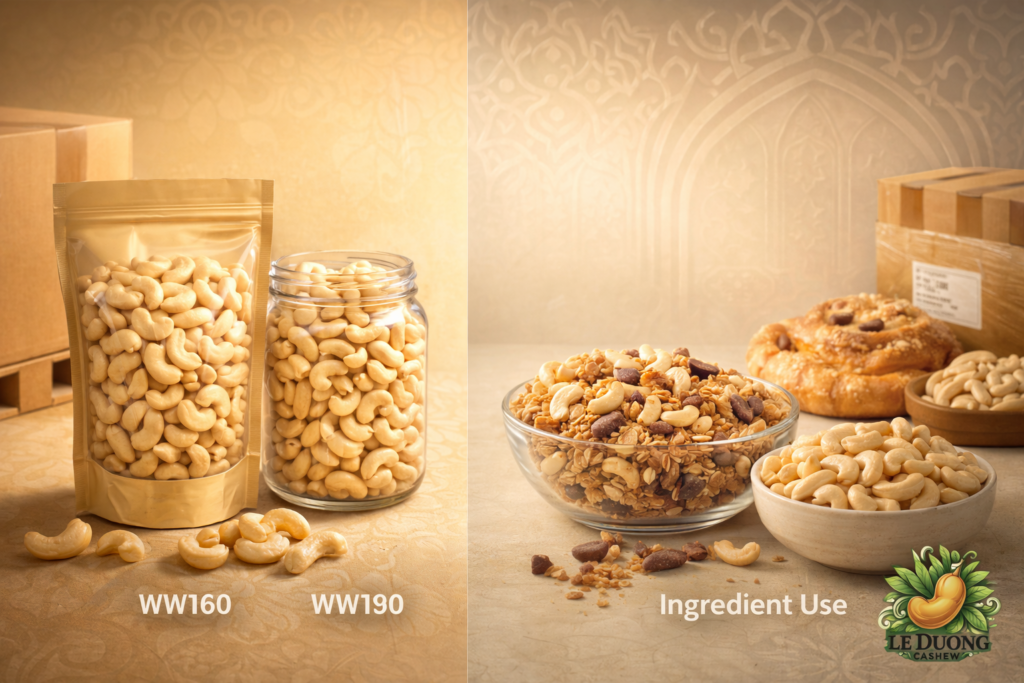
WW160: ~160 kernels/lb (large)
-
WW180: ~170–180 kernels/lb (large–medium)
-
WW240: ~220–240 kernels/lb (medium)
-
WW320: ~300–320 kernels/lb (medium–small)
Because agriculture is natural, exact counts can vary slightly lot-to-lot. What buyers should enforce is grade discipline (tight sorting), plus agreed tolerances on breakage, moisture, and defects.
3) WW160 vs WW180 vs WW240 vs WW320: what changes in the real world
Visual & eating experience
-
WW160: biggest “statement kernel,” premium look, strong bite.
-
WW180: premium look with better availability; still visibly large.
-
WW240: balanced size—still attractive, more cost-efficient, widely used.
-
WW320: smaller whole kernels; great value for many snack and ingredient uses where “giant kernels” aren’t required.
Cost per piece & serving control
If you sell by piece perception (e.g., “whole cashews” in a clear jar), larger kernels can justify a higher shelf price. If you sell by weight (standardized 30–50 g snack packs), WW240/WW320 often optimize margin because they’re easier to portion consistently.
Handling & breakage risk
Bigger kernels can be more vulnerable to breakage during:
-
vacuum packing compression
-
inland transport vibration
-
re-packing lines
A well-managed supplier will control broken ratio and provide COA-style reporting so you can predict performance.
Application fit: snack vs ingredient
-
For premium roasted & salted, honey-glazed, wasabi, or gift mixes, WW160/WW180 shine.
-
For mainstream roasted, trail mix, granola, bakery inclusions, WW240/WW320 often deliver better economics with stable supply.
Vietnam Cashew Grades WW160 vs WW180
4) Bonus: “Best for” table by grade
| Grade | Size (kernels/lb) | Look & Bite | Best For (Most Common) | Buyer Notes |
|---|---|---|---|---|
| WW160 | ~160 | Largest, premium bite | Premium snack jars, gift tins, hotel mini-bars, upscale nut assortments | Highest cost; insist on tight sorting, low breakage, consistent color |
| WW180 | ~170–180 | Large, premium | Branded snacks, roasted/seasoned cashews, nut blends where kernels are visible | Often best “premium vs availability” balance |
| WW240 | ~220–240 | Medium, versatile | Mainstream retail packs, trail mix, confectionery toppings, HoReCa prep | Great value; strong supply flexibility; stable portioning |
| WW320 | ~300–320 | Medium-small | Ingredient lines, bakery inclusions, cereal/granola, value snack packs | Cost-efficient; check defect limits + foreign matter control |
5) How to choose the right grade by channel
A) Retail snack brands (visible whole kernels)
Priorities: visual uniformity, roast performance, consistent bite.
-
Premium tier: WW160 / WW180
-
Core tier: WW180 / WW240
-
Value tier: WW240 / WW320
Tip: If packaging has a clear window, WW180 often delivers a premium look without WW160 pricing pressure.
B) E-commerce & gift bundles
Priorities: “wow factor,” low breakage on last-mile delivery.
-
Prefer WW160/WW180, but request packaging that protects kernels (vacuum level tuned; carton reinforcement; shock protection).
C) HoReCa (hotels, restaurants, catering)
Priorities: predictable portion cost, versatility across dishes.
-
WW240 is a strong default; WW180 for visible garnishes; WW320 for sauces, pilafs, and mixed dishes.
D) Bakery & confectionery (inclusions/toppings)
Priorities: mixing behavior, yield, defect control, moisture management.
-
WW240/WW320 typically optimize cost and throughput.
-
If cashews are used as a decorative topping, consider WW180/WW240.
E) Industrial ingredient buyers (mixing, chopping, grinding)
Priorities: food safety, foreign matter control, traceability, stable moisture.
-
WW320 is often the most economical whole grade; many buyers also consider splits/pieces (e.g., WS or butts) depending on the recipe and spec.
If you’d like a quick recommendation based on your channel, target pack size, and roasting profile, share your spec sheet and we’ll map the best-fit grades (inquiry link: https://yourdomain.com/inquiry).
6) QC approach that protects your brand
A reliable export program doesn’t just “ship a grade”—it controls risk in every lot:
-
Moisture control: keep within buyer-agreed limits to reduce rancidity risk and protect crunch.
-
Defect limits: agree on tolerances for scorched, spotted, shriveled, broken, and discoloration—then verify with documented sampling.
-
Foreign matter control: sieving, metal detection, and visual inspection aligned to food safety expectations.
-
Traceability: lot coding from raw intake through processing and packing; batch-level records for quick investigation if needed.
-
COA-style reporting: moisture, defect breakdown, count verification, packaging date, and batch code—shared before shipment or with shipping docs.
Many buyers also request programs aligned with HACCP and/or ISO-style systems. Where halal assurance is relevant, cashews are plant-based; buyer needs typically relate to handling, cross-contact controls, and documentation, which can be supported upon request subject to supply chain requirements.
7) Packaging & labeling options for export lots
Packaging should match your destination climate and downstream handling:
-
Bulk export cartons with inner bags (common for B2B)
-
Vacuum packing to protect freshness and reduce oxidation
-
Nitrogen flushing (upon request) for sensitive channels and longer shelf-life targets, subject to buyer specs
-
Labeling & batch coding: product grade, crop/production date where applicable, net weight, origin, lot code, and buyer-required marks
If you re-pack locally, ask for carton specs that reduce transit damage and maintain kernel integrity (especially for WW160/WW180).
8) Export documentation & clearance timing to avoid delays
Common export documentation (subject to contract and destination requirements):
-
Commercial invoice
-
Packing list
-
Bill of lading (B/L) or air waybill (AWB)
-
Certificate of origin (where applicable)
-
Test reports / COA as agreed (e.g., moisture and defect summary)
To avoid demurrage and clearance delays, align early on:
-
labeling language requirements
-
HS code usage and description consistency across documents
-
pre-alert timing (docs sent before ETA)
-
any destination-specific food safety paperwork requested by your importer
9) Logistics notes: lead time, container planning, and storage in hot climates
-
Lead time planning: reserve production slots ahead of peak periods; confirm cut-off dates for documentation.
-
Container/pallet strategy: stabilize pallets, use corner boards and stretch wrap; protect cartons from compression.
-
Hot/humid climates: use dry, ventilated warehousing; keep away from odor sources; control temperature swings to reduce quality drift.
For MENA and other warm regions, packaging choice (vacuum / nitrogen upon request) and inland storage discipline can be as important as the grade itself.
10) Supplier evaluation checklist (what buyers should verify)
Use this checklist to reduce surprises:
-
Can the supplier demonstrate grade discipline with count verification and sorting control?
-
Do they provide COA-style reports per lot (moisture, defect breakdown, lot code)?
-
What is their approach to foreign matter control (metal detection, sieves, documented inspections)?
-
Do they support traceability from intake to packed lot?
-
Do they have documented food safety systems (HACCP-aligned programs, audits, buyer questionnaires)?
-
Can they offer packaging options: vacuum, nitrogen upon request, export-ready cartons?
-
Are samples representative of the actual shipment lot, and is pre-shipment approval supported?
When you’re ready, send your target spec and destination—our team can propose the most suitable WW grade mix and packing format: https://yourdomain.com/inquiry.
Buyer FAQ
1) Is WW160 always “better” than WW320?
Not always. WW160 is larger and more premium visually, but WW320 can outperform on cost efficiency and processing stability depending on your channel and recipe.
2) Which grade is best for roasted & salted retail packs?
WW180 and WW240 are common choices. WW180 leans premium; WW240 balances appearance and cost.
3) How do I avoid receiving “mixed size” lots?
Request count verification and a COA-style report per lot, and confirm sampling method + acceptable tolerance before contract.
4) What should I watch for besides size?
Moisture, defect breakdown, foreign matter control, odor neutrality, and consistent batch coding/traceability.
5) Can cashew kernels meet halal requirements?
Cashews are plant-based; halal assurance typically focuses on handling, cross-contact controls, and documentation. Availability depends on the supply chain and buyer requirements, and can be supported upon request.