


Middle East supply chain disruption: a stress test for exporters and buyers

Middle East Supply Chain Disruption Export Risk Guide 2026
As of March 2026, the Middle East crisis is no longer just an energy-market story. It is now a supply-chain stress test affecting freight availability, marine insurance, booking confidence, delivery planning, and trade-finance decision-making across multiple export sectors. Reuters has reported a sharp rise in war-risk premiums in the Gulf, while the IMF has said it is monitoring disruptions to trade, energy prices, and financial markets.
For importers, the question is not only whether prices will move. The more important question is whether a supplier can still protect shipment continuity, documentation readiness, and communication discipline when routes, vessel schedules, and financing conditions become more volatile. Reuters also reported that Maersk temporarily suspended two shipping services linked to the region, showing how quickly operational decisions can change when risk intensifies.
Table of Contents
-
Why this matters to exporters and buyers in 2026
-
Product focus and grade planning under disruption
-
QC discipline when lead times become less predictable
-
Packaging and labeling choices that support shipment resilience
-
Export documents and clearance timing to avoid delay costs
-
Logistics planning, routing flexibility, and storage in hot climates
-
Supplier evaluation checklist for buyers
-
Buyer FAQ
Why this matters to exporters and buyers in 2026
Middle East disruption matters because it can affect more than one cost line at the same time. Exporters may face higher fuel-related surcharges, higher marine insurance costs, more selective booking acceptance, and longer transit planning windows. At the same time, buyers may see tighter quote validity, more cautious lead-time commitments, and closer scrutiny from banks or insurers on destination, route, and transaction structure. Reuters has reported that war-risk premiums for some voyages in the Gulf jumped from roughly 0.25% to as much as 3% of vessel value, while OFAC guidance makes clear that a U.S. financial institution cannot even advise a letter of credit if the underlying transaction would violate sanctions rules.
For food importers, snack brands, private-label buyers, and ingredient distributors, this means procurement decisions should now include route risk, documentation readiness, and contingency planning alongside price and quality. In other words, reliability is becoming a buying criterion, not just a service add-on.
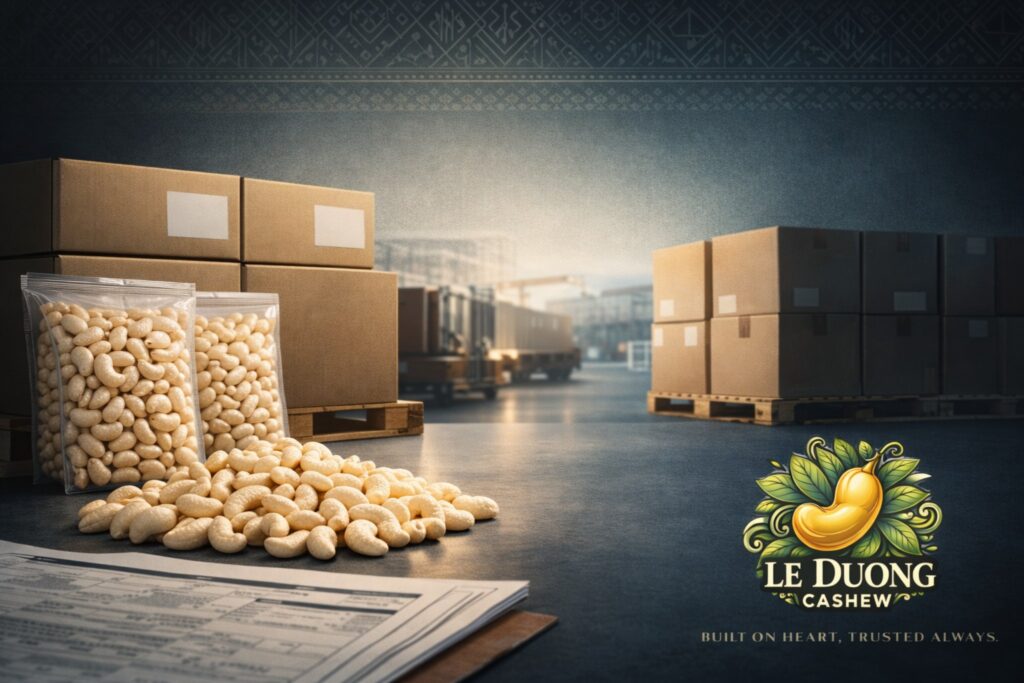
Middle East Supply Chain Disruption Export Risk Guide
Product focus and grade planning under disruption
For cashew exporters, disruption planning should start with grade discipline and use-case fit. Buyers still need clarity on which grades match their product application, even when logistics become less predictable.
Whole white kernels
WW320 is often the practical mainstream grade for retail packs, snack applications, and value-conscious private-label programs. WW240 is typically positioned for buyers wanting larger kernels with a stronger premium presentation. WW180 and WW160 are more suitable where visual appearance, larger count size, and premium gifting or higher-end snack positioning matter most.
Splits and pieces
WWS, WS, LWP, SWP, and related cuts can be useful for bakery, confectionery, butter, fillings, inclusions, and foodservice manufacturing where count size is less critical but consistency, cost control, and blending performance matter.
Why grade planning matters more during disruption
When freight conditions tighten, buyers may need flexibility between ideal grade and commercially workable grade. A supplier that can explain grade substitution logic, lot consistency, and practical use-case alternatives can support continuity better than a supplier that only quotes one SKU without fallback options.
In this environment, strong suppliers should present not only grade availability but also batch planning, replenishment windows, and packing options that match the buyer’s true channel requirements.
For buyers reviewing supply options during a volatile freight cycle, a practical framework is to match product grade, shipment urgency, and packaging efficiency before locking volume.
 QC approach: defect limits, moisture control, foreign matter control, traceability, and COA-style reporting
When logistics risk rises, quality-control discipline becomes even more important. Delays, transshipment changes, and storage exposure can increase the importance of moisture control, packaging integrity, and lot traceability.
A credible QC section should explain that the supplier works with defined incoming and finished-product checks, including visual grading, moisture monitoring, foreign-matter control, lot coding, and shipment release verification. It should also explain that COA-style reporting, photos, packing summaries, and batch references can be prepared in line with buyer specifications.
Cautious language is important here. Rather than making absolute compliance claims, it is better to say that documentation can support buyer QA review, product handling can be aligned with agreed food-safety procedures, and additional records may be available upon request, subject to supply-chain scope and buyer requirements.
For halal-sensitive markets, the wording should remain careful and practical: cashews are plant-based, while halal assurance generally relates to handling controls, cross-contact prevention, and documentation availability across the relevant supply chain. Certification or statements may be available upon request depending on buyer requirements and scope.
Packaging options: bulk cartons, vacuum, nitrogen upon request, and labeling discipline
Packaging should be presented as a risk-control tool, not only as a commercial detail.
Typical options can include bulk export cartons, inner vacuum formats, and nitrogen-flushed presentation upon request where commercially appropriate. Labeling should cover batch code, product description, origin details where applicable, production reference, and buyer-specific marks as agreed.
In a disrupted freight environment, buyers value packaging choices that support:
-
moisture stability,
-
loading efficiency,
-
pallet discipline,
-
easier batch identification,
-
faster warehouse intake,
-
cleaner claims handling if an issue occurs in transit.
A good article should also mention that final pack structure, carton strength, liner style, and pallet pattern should be confirmed against route length, climate exposure, and destination warehouse handling conditions.
Export documents: invoice, packing list, B/L or AWB, certificate of origin, aflatoxin test, non GMO test,… where applicable, and agreed test reports
Documentation readiness is one of the clearest signs of exporter maturity. When routes are unstable, delays become more expensive, and incomplete paperwork can turn a manageable shipment into demurrage, detention, or customs-hold exposure.
A practical export documentation section should mention commercial invoice, packing list, bill of lading or air waybill, certificate of origin where applicable, and agreed product test reports or quality records. The exact documentary set should always match destination requirements, payment terms, and product category.
Trade-finance caution matters here as well. OFAC states that financial institutions cannot advise letters of credit tied to prohibited underlying transactions, which is why banks and finance teams may become more conservative when conflict, sanctions exposure, or route complexity rises.
For exporters, the lesson is simple: pre-check documentation earlier, confirm consignee and route details sooner, and avoid assuming that a previously acceptable paperwork flow will be accepted unchanged during a higher-risk period.
 Logistics notes: lead time planning, container strategy, pallet decisions, and storage in hot climates
As of early March 2026, shipping conditions in and around the Gulf have become materially more uncertain. Reuters reported both a surge in marine risk pricing and the temporary suspension of two Maersk services tied to the region, while Saudi Aramco has increased Red Sea shipments as Hormuz disruption affected normal flows.
That does not mean every shipment will stop. It does mean exporters and buyers should plan with more buffers than usual.
Lead time planning
Build extra review time into quotation, booking, and pre-shipment stages. Quote validity may need to be shorter. Shipment windows may need a larger tolerance range. Buyers should request updates based on actual booking status, not only indicative schedules.
Container and pallet strategy
Where possible, align loading plans with destination handling conditions and route risk. Carton stacking strength, pallet type, wrap discipline, and container ventilation planning matter more when transit exposure becomes less predictable.
Storage in hot climates
For food products such as cashew kernels, hot-climate storage planning matters at both origin and destination. Clean warehousing, temperature-aware handling, moisture protection, and quick turnover after arrival can all help preserve product condition.
The strongest supplier message in this environment is not “we are cheapest.” It is “we can support continuity with realistic lead times, disciplined packing, batch traceability, and transparent shipment updates.”
Supplier evaluation checklist: what buyers should verify
Buyers should verify whether a supplier can provide:
-
clear grade specifications and practical substitution options,
-
batch-level traceability and COA-style reporting,
-
packaging options suitable for long or variable transit,
-
realistic quote validity and booking updates,
-
destination-aware export documentation,
-
route flexibility and forwarder coordination,
-
evidence of disciplined communication when conditions change.
They should also ask whether the supplier can separate product cost from volatile logistics cost components, explain Incoterm implications clearly, and flag risk points before they become claims.
A well-prepared exporter should be able to explain not only what is available, but also how shipment continuity will be managed if freight conditions tighten further.
Conclusion
Middle East disruption is not only a regional headline. It is a practical test of procurement discipline, logistics planning, and supplier reliability. For exporters, it raises the standard for quote control, packing logic, documentation readiness, and buyer communication. For importers, it reinforces the value of suppliers who can combine product quality with route awareness and risk-control discipline.
In 2026, buyers are likely to remember not only who offered a competitive price, but who helped protect delivery continuity when freight, insurance, and finance conditions became more difficult. Reuters, the IMF, and current shipping developments all point to the same conclusion: volatility is real, and planning quality now matters more than ever.
To review sourcing options, packing formats, and shipment planning with a practical export lens, visit link.
Buyer FAQ
1. Does Middle East disruption always mean shipments will stop?
No. It means shipment planning may require more caution, more flexible routing, and closer coordination with carriers, insurers, and finance teams.
2. Why are buyers seeing shorter quote validity periods?
Because freight, insurance, and booking conditions can change faster during conflict-related disruption, making long validity periods harder to guarantee.
3. Can plant-based cashew products support halal market requirements?
Cashews are plant-based, but halal assurance usually depends on handling controls, cross-contact management, and available documentation across the relevant supply chain.
4. What should buyers ask for before confirming an order?
Ask for grade specs, pack details, batch coding logic, document list, route assumptions, shipment timeline range, and any buyer-specific QA records required.
5. What makes one supplier more resilient than another in a volatile market?
Usually it is a combination of grading discipline, documentation readiness, packing consistency, realistic communication, and logistics coordination.