

Cashew Price Volatility 2026: Contract Structures that Protect Both Sides
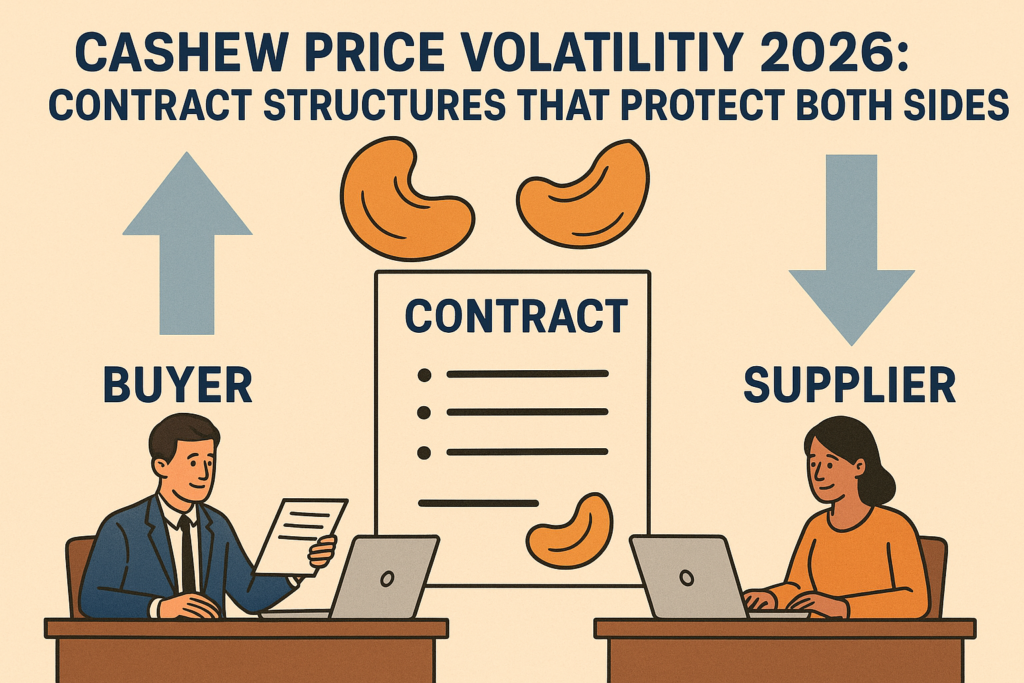
Cashew Price Volatility 2026 Contract Structures that Protect Both Sides
Cashew buyers and suppliers step into 2026 with the same familiar headache: prices move fast. Raw cashew nut crops, freight rates, currency swings, and changing demand all push the market up and down. Instead of trying to “guess” the perfect moment, professional buyers focus on something more realistic: good contract structures that share risk fairly.
Below is a simple, friendly guide to three ways you can structure cashew contracts for grades like WW320 and WW240.
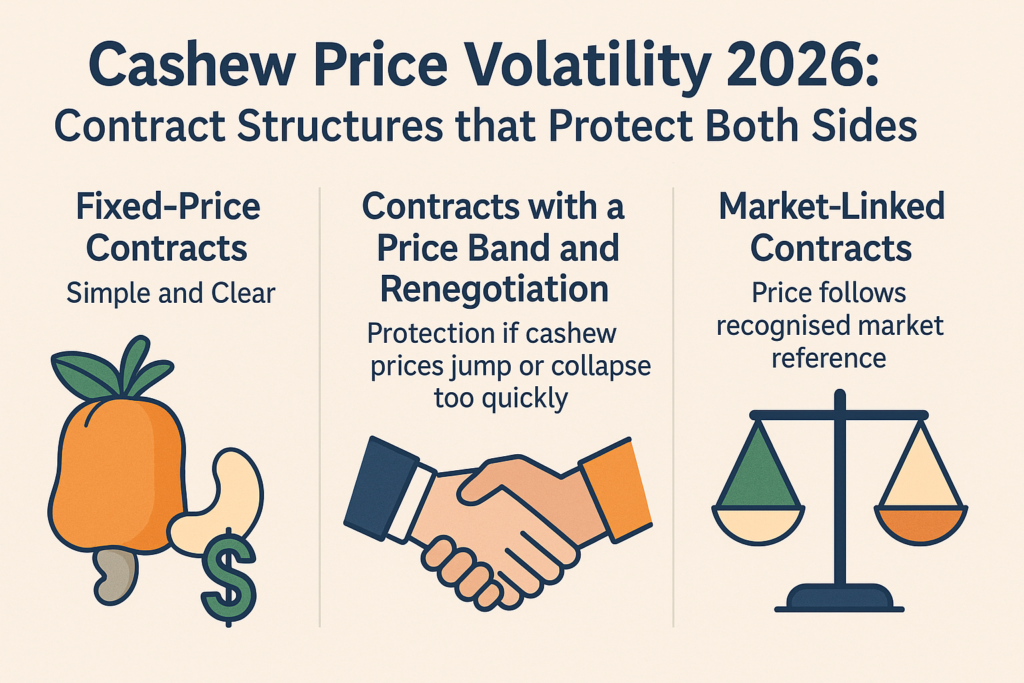
1. Fixed-Price Contracts – Simple and Clear
With a fixed-price contract, you and your supplier agree on one price per kilogram for a certain period and volume – for example, six or twelve months, with regular shipments.
When this works well:
-
You sell to retailers or big customers who need price stability.
-
You already know your demand and can plan volumes ahead.
Why buyers like it
-
Easy budgeting and margin planning.
-
Simple story to tell your finance and sales teams.
What to watch
-
If the market falls, you may feel stuck above spot.
-
If the market rises sharply and the supplier is not well covered, the relationship may be under pressure.
For many companies, fixed price is still the “core” of their program, especially for key SKUs.

Cashew Price Volatility 2026 Contract Structures that Protect Le Duong’s Customer
2. Contracts with a Price Band and Renegotiation
Here, you still agree on a starting price, but you also agree on a reasonable movement range.
For example, you can agree that:
-
If the market only moves a few percent up or down, both sides accept it and keep the original price.
-
If the market moves beyond that range, you sit down and review the price together.
This kind of clause protects both sides from extreme changes without forcing constant renegotiation.
Why buyers like it
-
Protection if cashew prices jump or collapse too quickly.
-
Keeps the partnership feeling fair over a longer period, such as a full year.
Why suppliers like it
-
They can commit production capacity and raw material for you, knowing there is a way to adjust if the world changes too much.
The key is to define clearly how you measure the “market move” and how you will talk when the threshold is crossed.
3. Market-Linked Contracts
In a market-linked structure, the price you pay follows a recognised market reference plus an agreed premium or discount. Instead of one number for the full year, the price is updated regularly, for example monthly, based on that reference.
What this offers buyers
-
Your cost follows the real cashew market more closely.
-
Very transparent for internal reporting and for your customers.
What this offers suppliers
-
They can align their raw cashew purchases with your kernel program.
-
More confidence to support long-term, year-round supply.
These contracts are a bit more complex to explain, but they are often one of the fairest tools for both sides when volumes and horizons are large.
Choosing the Right Structure for 2026
There is no single best answer. Ask yourself:
-
How fixed are your own selling prices?
-
How much short-term margin fluctuation can you accept?
-
How clearly can you see your demand for the next 6–12 months?
-
How strong and transparent is your relationship with your supplier?
In practice, many smart buyers combine all three:
-
A fixed price for a base volume of WW320 and WW240.
-
A price-band contract for extra or promotional volumes.
-
A market-linked structure for flexible or strategic programs.
How We Support You at Le Duong Cashew
Le Duong Cashew focus on long-term partnership
At Le Duong Cashew, we treat contracts as tools to protect both your business and ours.
When you share your 2026 plan with us, we:
-
Review your grades and volumes (WW320, WW240, and others).
-
Understand your risk profile and markets.
-
Propose one or two contract structures that balance stability and flexibility.
-
Fix clear quality specs, documents, and a fair way to handle claims.
If you are preparing your cashew procurement strategy for 2026 and want to reduce the stress of price volatility, we are ready to discuss a structure that fits your reality – not just today’s spot price.