

Vietnam Cashew Market April 2026: What Importers Are Really Signaling
The April 2026 Vietnam cashew market shows a clear message for international buyers: demand remains active, but purchasing decisions are becoming more disciplined, data-driven, and risk-sensitive. For food manufacturers, distributors, wholesalers, snack brands, and ingredient buyers, the question is no longer simply “Where can we buy cashew kernels?” The stronger question is: “Which supplier can deliver consistent grades, reliable documentation, and stable execution from Vietnam?”
According to Le Duong Cashew’s April 2026 Cashew Importers Report, the reviewed shipment scope covered HS 08013200 only, excluding HS 08013100, with 7,111 shipment rows included. Total shipment quantity reached 110,851.924 MT, with total value of USD 787.77 million and a weighted average price of USD 7.1065/kg. These figures point to a market with substantial importer activity across multiple grades and transaction structures.
A Market Built on Scale, But Won by Consistency
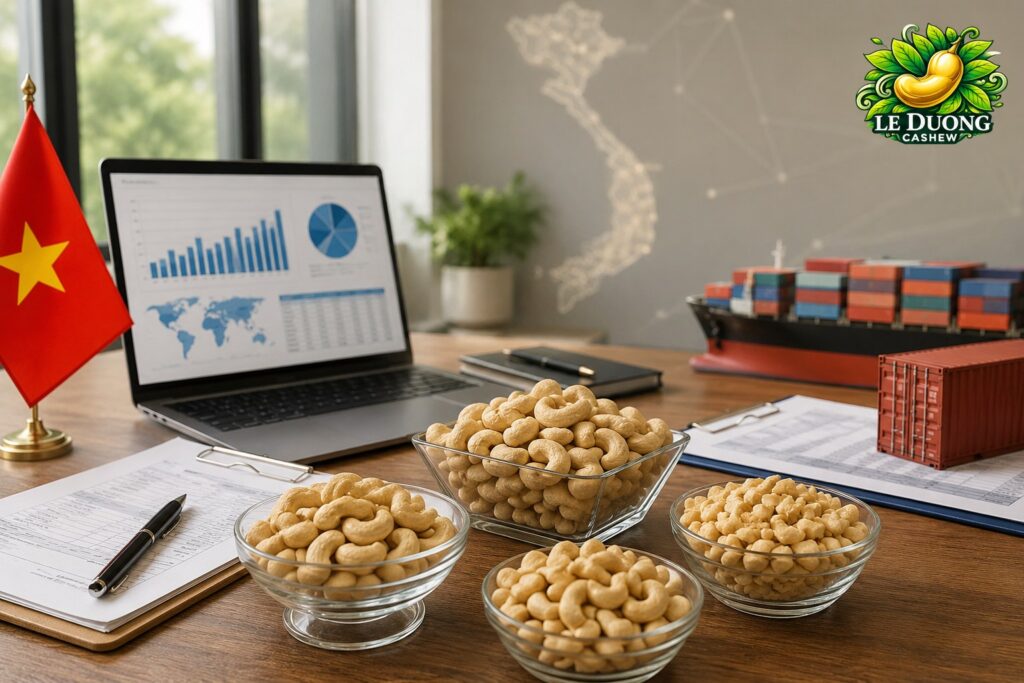
Vietnam Export-Ready Cashew Intelligence
Vietnam continues to hold a central position in the global cashew supply chain. Recent industry reports indicate that Vietnam’s cashew sector is still targeting around 800,000 tonnes of kernel exports worth approximately USD 5 billion in 2026, despite pressure from raw material costs, logistics, and weaker demand in some major markets.
This context matters. When buyers face volatile freight, raw nut cost pressure, and changing consumer demand, they naturally become more selective. Price remains important, but procurement teams increasingly value predictability. A supplier that can maintain grade accuracy, shipment timing, moisture control, packing standards, and document discipline can reduce operational risk for importers.
This is where Vietnam-based suppliers such as Le Duong Cashew can create stronger commercial value. The April data does not only show trade volume; it shows that importers are actively sourcing across multiple grade categories and incoterms, which means buyers need flexible, professional partners capable of serving different purchasing models.
Grade Mix: WW320 and W320 Remain Core Commercial Grades
The April 2026 report shows a broad grade mix. Unspecified grade shipments represented the largest category at 33,433.091 MT, followed by WW320 at 23,312.944 MT, W320 at 14,460.320 MT, WW240 at 11,017.801 MT, and W240 at 9,103.984 MT. Premium larger grades such as WW180 and W180 also appeared with higher average prices, reflecting their positioning for premium applications.
For F&B buyers, this grade structure is commercially meaningful. WW320 and W320 remain highly practical for snack roasting, retail packs, trail mixes, chocolate inclusion, bakery topping, and general food manufacturing. WW240 and W240 offer a larger visual profile, suitable for premium snack products or gifting segments. Broken grades such as WS, LP, and SP remain important for processing applications, including cashew butter, plant-based sauces, confectionery fillings, bakery mixes, and industrial ingredient formulations.
The key takeaway is that Vietnam cashew sourcing should not be treated as a single-product purchase. A good procurement strategy matches grade, application, price level, packing format, and delivery schedule. For example, a snack brand may prioritize whole white kernels with strong visual appeal, while a sauce producer may focus on clean broken grades with stable flavor and competitive cost.
Pricing Signals: Weighted Average Matters More Than Spot Noise
The report’s weighted average price of USD 7.1065/kg provides a useful reference point, but buyers should avoid reading this number in isolation. Cashew pricing is shaped by grade, shipment size, incoterm, destination, quality specifications, and timing. In the April report, WW320 FOB shipments reached 15,573.713 MT with a weighted average of USD 6.9034/kg, while WW240 FOB shipments reached 6,402.303 MT with a weighted average of USD 7.0408/kg.
This reinforces an important sourcing principle: buyers should compare prices only when the full specification is clear. A lower quote may not be better if it comes with unclear grade, inconsistent sizing, weak packing, unreliable ETD, or incomplete documentation. In international cashew trade, the lowest visible price can become expensive if it creates claims, delays, rejections, or production disruption.
Le Duong Cashew can strengthen its positioning by communicating grade specifications clearly, aligning samples with shipment quality, and supporting buyers with transparent documentation. For importers, that kind of execution helps reduce procurement risk.
Importer Demand: Established Buyers Still Drive Volume
The April report also shows that demand is concentrated among established industrial buyers and trading groups. The top masked importer group by quantity reached 19,275.058 MT, followed by other large buyers above 8,000 MT and 4,700 MT. This suggests that professional importers continue to rely on Vietnam for sizable kernel procurement.
For Vietnamese exporters, this creates both opportunity and pressure. Large buyers usually expect more than product availability. They expect responsive communication, stable loading plans, traceable paperwork, consistent moisture and defect control, and the ability to coordinate repeat shipments.
In other words, the market rewards suppliers who operate like long-term partners rather than one-time sellers.
What This Means for Global Food Buyers
For international F&B companies, April 2026 data supports three practical sourcing actions.
First, secure core grades early. WW320, W320, WW240, and W240 are widely used and commercially active. Buyers with recurring production schedules should avoid depending only on spot-market availability.
Second, align grade with application. Whole kernels are ideal for premium retail and roasting, while pieces and splits may deliver better value for industrial processing.
Third, choose suppliers based on execution capability. The best Vietnam cashew partner should help buyers manage quality, timing, documentation, and communication—not merely offer a price.
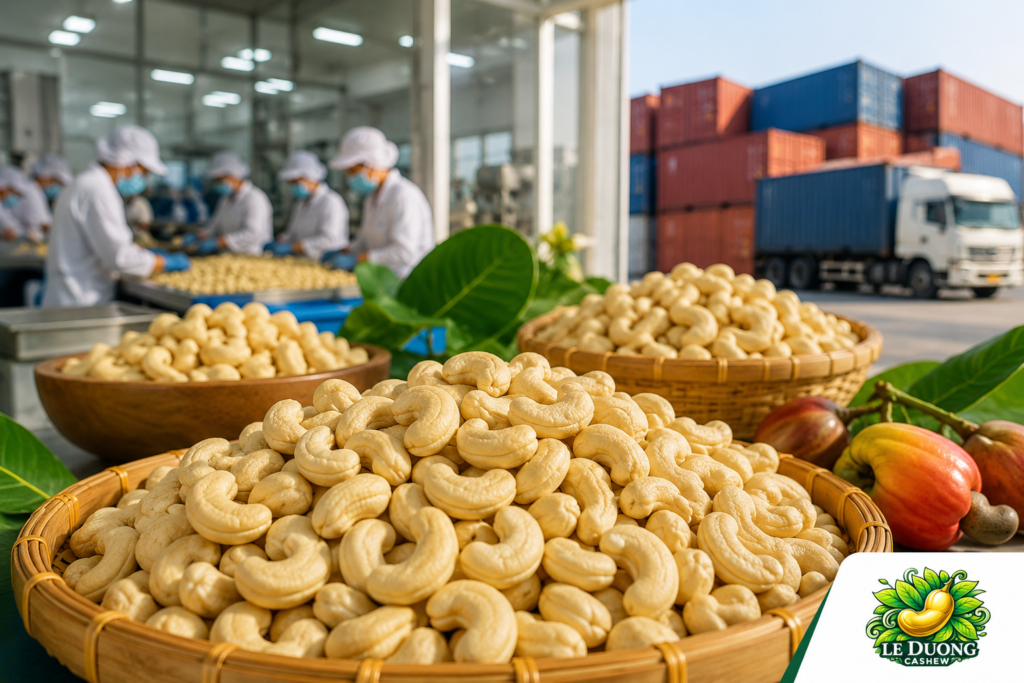
Vietnam Cashew Supply Chain to the World
Le Duong Cashew: A Reliable Vietnam-Based Partner
The April 2026 market confirms that global cashew demand remains broad and commercially significant. At the same time, sourcing is becoming more strategic. Buyers want confidence: stable supply, clear grade control, professional export handling, and long-term support.
Le Duong Cashew is well positioned to serve this need as a Vietnam-based cashew supplier focused on dependable quality, practical communication, and export-ready execution. For importers, wholesalers, and food manufacturers, the strongest sourcing advantage is not only buying from Vietnam—it is buying from a partner who understands how to make Vietnam cashew supply reliable.