
Vietnam Cashew Importer Report Feb 2026
For procurement teams, brand owners, and ingredient importers, a monthly importer report is more than a market update—it’s a practical way to benchmark demand, validate price positioning, and prioritize buyer outreach by grade and delivery term.
This Feb 2026 snapshot compiles importer-side activity derived from Vietnam export declarations (excluding Vietnam as destination) across cashew HS codes 08013200 / 08013100 / 20081910.
In Feb 2026, total declared shipments in scope reached ≈21,858.777 MT with total declared value $146,638,238 and a weighted average price of 6.7084 USD/kg (value ÷ quantity, normalized to USD/kg).
Table of Contents
-
Why this Feb 2026 report matters to importers
-
What products and grades are moving (and why it matters)
-
Importer concentration: what “top buyers” implies for negotiation
-
Pricing signals by grade × Incoterm (how to interpret)
-
QC approach that supports repeat contracts
-
Packaging and labeling options for export programs
-
Export documentation pack to reduce clearance risk
-
Logistics notes: lead time, containers, and storage in hot climates
-
Supplier evaluation checklist for importer audits
-
Buyer FAQ
-
Internal Links (Suggestions)
1) Why this Feb 2026 report matters to importers
A clearer view of “where demand is actually landing”
Market headlines can lag. Importer-level shipment activity helps buyers and sellers align on:
-
Demand concentration (how many buyers control meaningful volume)
-
Grade preference (e.g., WW-style grades vs small pieces/brokens)
-
Delivery-term patterns (FOB vs CFR/CIF mixes affect landed-cost strategy)
This report is built from Vietnam customs declarations (currency USD; units kg/MT), with importer names masked in the public-safe HTML output.
Feb 2026 executive snapshot (what it signals)
-
Total Quantity: ≈ 21,858.777 MT
-
Total Value: $146,638,238
-
Weighted Avg Price: 6.7084 USD/kg
Practical takeaway: this average is a blended market signal across grades and terms. Your buyer-spec (WW320 vs brokens; FOB vs CFR/CIF) can materially shift the expected range.
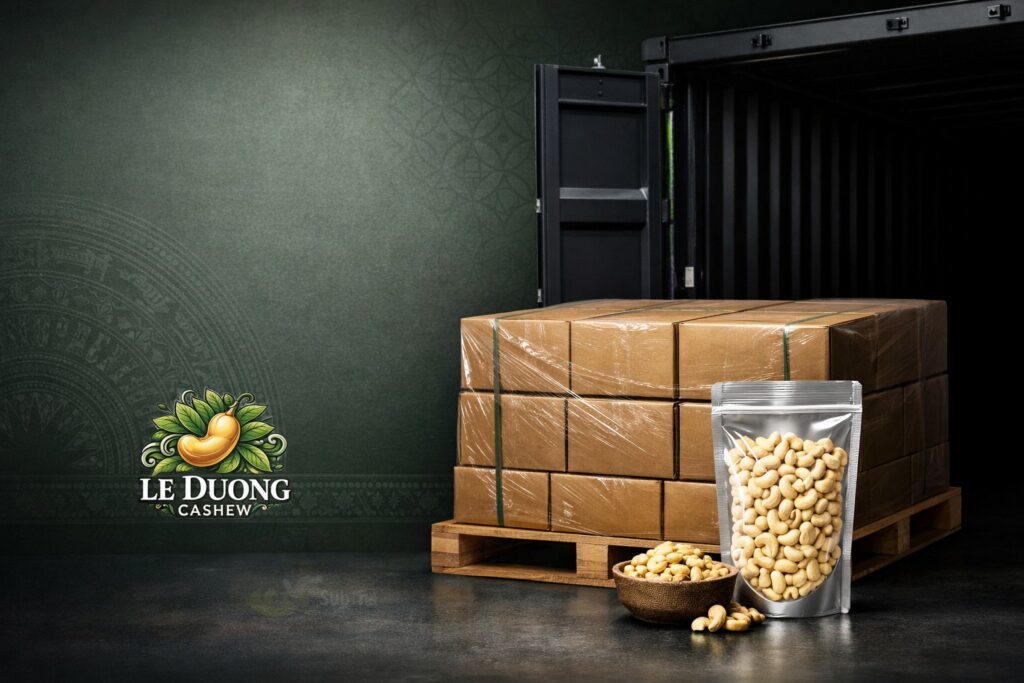
Vietnam Cashew Importer Report Feb 2026, Buyer Insights
2) Product focus: which grades are visible in the Feb 2026 flow
Most global procurement programs anchor around whole whites (WW320 / WW240 / WW180) for retail and industrial use, then complement with pieces/brokens for confectionery, bakery, and ingredients.
From the report’s grade table (top grades shown), Feb 2026 included activity such as:
-
WW320: 5,578.230 MT (avg 6.5414 USD/kg)
-
WW240: 4,187.035 MT (avg 7.0749 USD/kg)
-
WW180: 2,985.634 MT (avg 7.9769 USD/kg)
-
SP003: 15.876 MT (avg 5.4674 USD/kg)
-
LP21: 16.556 MT (avg 4.4533 USD/kg)
How importers typically use this:
-
WW320: mainstream snack packs, private label, mid-price positioning
-
WW240 / WW180: premium lines, larger kernels for visual impact
-
Pieces/brokens (WS/SW/SP/LP codes): cost optimization in bars, spreads, bakery, and industrial inclusion.
If you want outreach guidance by grade + Incoterm fit, explore our buyer-support workflow at: https://leduongcashew.com/en/.
3) Importer concentration: why “top buyers” change the negotiation dynamics
Feb 2026 demand appears concentrated among a smaller set of large global buyers (masked in public output). In the Top Importers by Quantity table, leading masked buyer entries include (examples):
-
OLAMI — 2,554.385 MT — $17,772,143 — avg 6.9575 USD/kg
-
REDRI — 1,389.215 MT — $9,467,719 — avg 6.8152 USD/kg
-
THERI — 584.518 MT — $4,079,799 — avg 6.9798 USD/kg
-
KHALS — 542.311 MT — $3,830,459 — avg 7.0632 USD/kg
-
AGRIC — 412.741 MT — $2,657,900 — avg 6.4396 USD/kg
What importers can do with this insight:
-
Benchmark your purchasing program against buyer concentration (are you competing for the same capacity windows?)
-
Align negotiation levers: spec discipline, packaging standardization, shipment cadence, and payment structure
-
Use a grade-term lens: the same buyer may buy WW320 FOB but switch to WW240 CFR/CIF depending on logistics seasonality
4) Price by grade × Incoterm: how to interpret the tables
The report splits pricing into tables per grade, showing Min / Avg (weighted) / Max by Incoterm (e.g., FOB).
Example visible entries:
-
LP21 — FOB: 16.556 MT at 4.4533 USD/kg (min/avg/max equal in this row)
-
LP22 — FOB: 17.010 MT at 4.5414 USD/kg
Importer interpretation tips (practical):
-
Treat the “avg” as weighted by volume—not a simple average—helpful for budgeting
-
Separate decisions:
-
Quality decision: grade + defect limits + moisture target
-
Landed-cost decision: Incoterm + freight + insurance + destination handling
-
-
Use Incoterm patterns to structure quotes: if your program is CFR/CIF-heavy, price comparisons to FOB-only trades can mislead.
5) QC approach importers can request to reduce claim risk
For consistent receiving outcomes (and fewer debit notes), align on a QC packet that can support buyer specs, such as:
-
Moisture control (target range agreed by contract; monitored per lot)
-
Defect limits aligned to grade (splits, scorches, pieces %, foreign matter)
-
Foreign matter control (sieving, magnets/metal detection steps, visual inspection)
-
Traceability by batch code (production date, packing date, lot ID, container seal mapping)
-
COA-style reporting (lot-by-lot summary that can support your QA file)
Where needed, documentation can be provided upon request and subject to buyer specifications.
6) Packaging options and labeling for importer programs
Common export pack formats that importers specify:
-
Bulk cartons (food-grade inner liners)
-
Vacuum packing (where required for freshness and oxidation control)
-
Nitrogen flush (upon request, subject to packing line capability and buyer spec)
Labeling best practices:
-
Clear batch/lot coding, net weight, grade, crop/production references, and destination marks
-
Pallet markings aligned with warehouse receiving (SSCC labels if the importer requires)
7) Export docs checklist to avoid clearance delays and demurrage
A documentation bundle that importers typically require:
-
Commercial invoice
-
Packing list (carton count, net/gross weights, palletization)
-
B/L or AWB
-
Certificate of origin (where applicable / as agreed)
-
Agreed test reports (as specified in contract)
Tip: align the paperwork flow with your forwarder’s cut-off schedule to reduce release delays at destination.
8) Logistics notes: lead time planning and storage in hot climates
Importer-side planning considerations:
-
Build buffer for production + packing + port cut-off timing
-
Container strategy: pallet configuration, desiccant (when applicable), and temperature exposure risk
-
Hot climate warehousing: minimize time at uncontrolled docks; keep cartons off floors; enforce FIFO; monitor humidity
9) Supplier evaluation checklist importers can use
Before awarding a program (or renewing), verify:
-
Grade discipline (WW320/WW240/WW180, pieces/brokens) and inspection method
-
Lot traceability + batch coding system
-
QC controls for moisture, defects, and foreign matter
-
Packaging capability (vacuum/nitrogen upon request)
-
Documentation readiness (invoice/PL/B-L/COO/test reports as agreed)
-
Claims & corrective-action handling process
-
Trade references and shipment consistency
10) Buyer FAQ
Q1: Is the Feb 2026 average price a quote I can buy at?
No—6.7084 USD/kg is a blended weighted average across grades and terms; your grade and Incoterm can shift the expected range.
Q2: What grades should I prioritize for a mainstream snack line?
Typically WW320 for broad-market packs; WW240/WW180 for premium positioning; pieces for inclusions and cost optimization.
Q3: Why are importer names masked in the report?
The HTML output is designed for public-safe sharing; full buyer details can be handled internally upon request.
Q4: How should I choose between FOB and CFR/CIF?
Use your logistics capability: FOB gives control over freight; CFR/CIF can simplify landed-cost planning. The report highlights Incoterm mix patterns to support this alignment.
Q5: Are cashews halal?
Cashews are plant-based; halal assurance usually relates to handling/cross-contact controls and documentation. Certification can be discussed upon request and subject to supply-chain requirements.
If you want to align a buying program to WW320/WW240 demand pockets and the FOB/CFR pattern highlighted in this Feb 2026 snapshot, contact our team here: https://leduongcashew.com/en/.